
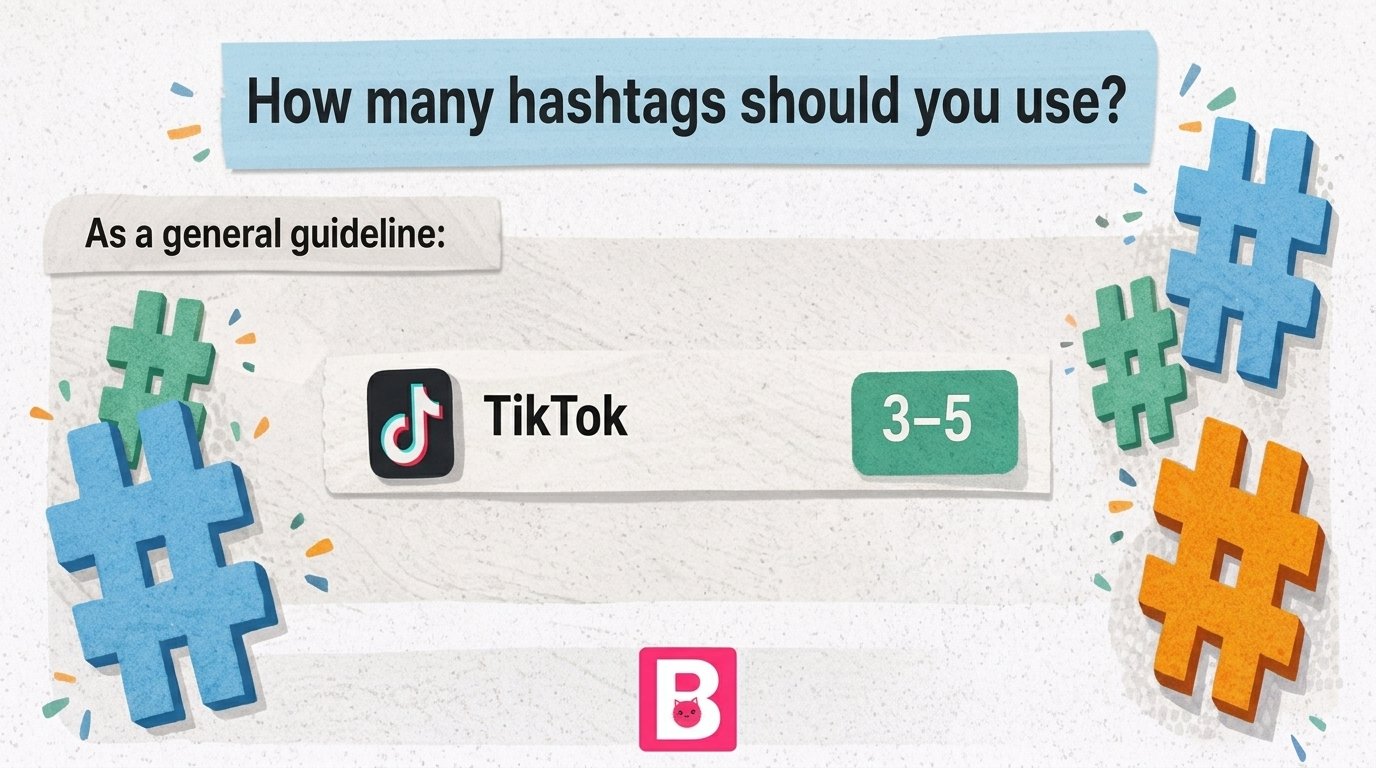
How many hashtags should I use on TikTok? For most creators and brands, 3 to 5 relevant hashtags per video is the sweet spot. TikTok has publicly suggested keeping hashtags focused, and there is no official number that guarantees more views. What matters most is relevance, not volume.
This guide draws on TikTok's own creator guidance and on widely shared testing practices from social media teams. It explains how hashtags work, which mistakes hold accounts back, and how to choose the best TikTok hashtags for your content. If you have your own performance data, add a short note about your results near the top. First hand experience strengthens trust with both readers and search engines.
How Do TikTok Hashtags Work?
A hashtag is a keyword or phrase with a pound sign in front of it. On TikTok, clicking or searching a hashtag opens a page of videos that use it. That is the basic mechanic, but hashtags do more than organize content.
TikTok's recommendation system studies many signals to decide who sees your video. These include what your video is about, how viewers react to it, and information about the video itself, such as captions, sounds, and hashtags. Hashtags act as context clues. They help the system understand your topic, and they help viewers find you when they search.
There are three ways people typically run into your hashtags:
- Search results. Viewers type a topic into the search bar and browse related videos and hashtag pages.
- The For You feed. The algorithm matches your video to people who have shown interest in similar topics.
- Hashtag pages and challenges. Branded or trending challenges collect videos under one tag, which can create bursts of visibility.
It helps to think of hashtags as labels rather than magic tricks. A good label tells the system and the viewer what to expect. A confusing or misleading label creates the opposite effect. If people click your video expecting one thing and leave after two seconds, that behavior tells TikTok the video did not match its label.
Hashtags also fall into rough categories. Broad hashtags, such as those covering entire industries or interests, have enormous audiences and heavy competition. Niche hashtags have smaller audiences but attract viewers with a specific interest. Branded hashtags belong to a company or creator and help track campaigns. Trending hashtags rise quickly because of a challenge, event, or sound. A healthy strategy usually blends several of these instead of relying on only one.
How Many Hashtags Should I Use on TikTok: Common Mistakes Explained
Knowing the right number is only part of the puzzle. Many accounts follow the advice on quantity and still struggle because of these five mistakes.
Mistake 1: Adding Too Many Hashtags
The most common error is treating hashtags like a lottery ticket. Creators paste twenty or thirty tags under every video, hoping one will catch. This tends to backfire for several reasons.
A long block of hashtags makes the caption look cluttered and can push out useful text. It also blurs your topic. If a cooking video carries tags about travel, fitness, fashion, and comedy, the system receives mixed signals. Finally, a crowded caption looks spammy to viewers, which can reduce trust.
Keep the list short. Three to five well chosen hashtags almost always communicate your topic more clearly than twenty vague ones.
Mistake 2: Relying Only on Huge, Broad Hashtags
Popular tags attract millions of videos. Your new post lands in a fast moving pile and disappears within minutes. Relying only on the biggest tags means you compete with every large account at once.
A better approach is to mix sizes. Pair one broader tag with two or three more specific ones. For example, a home baker might combine a general baking tag with tags about sourdough for beginners or a specific recipe. The specific tags reach fewer people, but those people are far more likely to watch, like, and follow.
Mistake 3: Using Irrelevant Trending Hashtags
It is tempting to attach a trending tag to every post. If your video has nothing to do with the trend, this usually hurts more than it helps. Viewers who arrive through the trend leave quickly, and that low engagement signals a mismatch.
Join a trend only when you can add something honest to it. Use the trending tag when your content genuinely fits, and skip it when it does not. Chasing every trend also makes your profile feel unfocused, which weakens long term growth.
Mistake 4: Ignoring Keywords in Captions, On Screen Text, and Speech
Many people think hashtags are the only way to be discoverable. TikTok is increasingly used as a search engine, and its system reads more than your tags. Captions, on screen text, spoken words, and even the video content itself contribute to understanding.
If you say and show your topic clearly, the hashtag becomes a supporting signal rather than the only one. Write a caption that includes the phrase a viewer would actually search for, then add your hashtags after it. This layered approach outperforms tag only captions for most niches.
Mistake 5: Copying the Same Set and Never Measuring
Some creators save a fixed block of hashtags and paste it under every post for months. The problem is that every video has a different topic, and what worked last month may not work now. Trends shift, audiences change, and tags rise and fall in popularity.
Treat your hashtag choices as experiments. Review your analytics, note which videos reached new viewers, and compare the tags you used. Over a few weeks, patterns appear. You may find that a certain niche tag consistently brings engaged viewers, while a popular tag brings none. Adjust your list based on evidence, not habit.
Hashtag Best Practices for Your TikTok Strategy
Once you avoid the mistakes above, these best practices help you build a repeatable system.
Start with your audience, not the hashtag. Ask what your ideal viewer would type into the search bar. Then choose tags that match those phrases. This keeps you focused on real demand instead of guesswork.
Use a simple three layer structure. Many social media managers build each caption with one broad tag, one or two niche tags, and one branded or campaign tag. This is sometimes called a tiered approach. It balances reach, relevance, and brand recognition without overloading the caption.
Place hashtags after your main message. Lead with a clear, engaging caption that gives viewers a reason to watch. Put the tags at the end so they support the caption rather than distract from it.
Keep tags accurate. Only use a hashtag if it describes your video. Accurate labeling improves viewer satisfaction, and satisfied viewers watch longer, share more, and comment more. Those behaviors matter far more than the tag itself.
Combine hashtags with strong content. No hashtag can rescue a weak video. The first few seconds, the clarity of your message, and the value you offer determine performance. Hashtags simply help the right people find something worth watching.
Stay consistent within your niche. Returning to a handful of core tags helps TikTok understand what your account is about. Over time, that clarity can improve how well your videos reach the right audience.
Respect platform rules. Avoid banned or restricted tags, do not use misleading tags to gain views, and follow TikTok's community guidelines. Spam tactics can limit your reach and put your account at risk.
For a quick starting list, you can also try a free tool such as the Bilipedia TikTok hashtag generator to brainstorm ideas, then filter them by relevance before you post.
Tips to Find Relevant Hashtags on TikTok
Finding the right tags takes a little research, but the process is simple. Here are practical methods you can use today.
1. Use TikTok's own search suggestions. Type a keyword into the search bar and note the autocomplete suggestions. These reflect what people actually search for, which makes them excellent hashtag and caption ideas.
2. Check the TikTok Creative Center. TikTok publishes trending hashtag data that you can filter by region and time period. This is one of the most reliable ways to see which tags are rising. Explore the TikTok Creative Center hashtag trends page to find trending TikTok hashtags for the past seven days in the United States, and adjust the region to match your audience.
3. Study similar creators. Look at accounts in your niche that have strong engagement. Note which tags they use repeatedly. Do not copy them blindly, but use their choices as inspiration.
4. Look at the video count on each hashtag. Very large tags are crowded, while tiny tags may have almost no audience. Aim for a range that gives your video a fair chance of being seen.
5. Read the top videos under a tag. Before using a hashtag, open its page and watch the top videos. If the content looks nothing like yours, the tag is not a match.
6. Build a personal hashtag bank. Keep a simple note or spreadsheet grouped by topic. Add tags that performed well, remove those that did not, and refresh the list every month. This saves time and keeps your strategy grounded in data.
7. Watch for seasonal and event based tags. Holidays, sports seasons, and cultural moments create short windows of high interest. If your content fits, timely tags can add a boost.
A note on popularity: lists of popular TikTok hashtags, top TikTok hashtags, and the best TikTok hashtags change constantly. Any fixed list published today may be stale in a few weeks, so treat lists as a starting point and confirm current trends before you post.
Make the Most of Your Hashtags for Tiktok with Juicer Social Wall
Once people start using your branded hashtag, you can turn that activity into a marketing asset. This is where a social aggregator such as Juicer can help.
Juicer is a tool that collects social media posts from different platforms based on hashtags, handles, or keywords, and displays them together in a feed or social wall. For a brand that runs a TikTok campaign, this can be useful in several ways:
- Showcase user generated content. When customers post videos with your campaign hashtag, you can feature that content on your website, in a store display, or at an event.
- Build social proof. Visitors trust real customer posts more than polished advertising. A live wall of authentic content shows that people enjoy your products.
- Encourage participation. Knowing their video might appear on a public wall motivates fans to join your challenge.
- Keep your content in one place. Instead of searching manually for every mention, you can review the collected posts from a single dashboard.
Before displaying any user content, make sure you have permission or that your campaign terms cover it, and check each platform's rules on embedding and reuse. Features and integrations can change, so confirm current TikTok support and pricing directly on Juicer's website before you commit to a plan.
A social wall works best when your hashtag is unique, short, and easy to spell. Pick a clear campaign tag, promote it in your videos and captions, and let the wall reward participants with visibility.
How Many Hashtags Should You Use on TikTok to Maximize Views?
Here is the direct answer: aim for 3 to 5 targeted hashtags per video. This range is short enough to keep your caption clean and long enough to cover your topic, your niche, and your brand.
Why does this range work so well? There are three main reasons.
Clarity. A small set of tags gives TikTok a focused picture of your content. Each tag reinforces the same message instead of pulling in different directions.
Readability. Viewers see a tidy caption and can absorb your message quickly. Cluttered captions make people scroll past.
Flexibility. With a handful of tags, you can test different combinations across videos and learn what works, which is difficult when every caption has twenty tags.
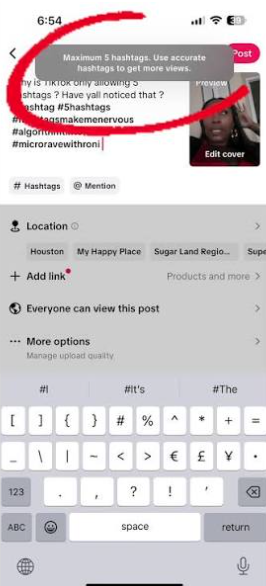
That said, this is a guideline, not a law. Some videos may perform well with two tags, and others may do fine with six or seven. What you should avoid is extremes. A single vague tag gives little context, while a wall of tags creates noise.
A useful way to test is to run a simple experiment over a month:
- Post similar videos using two, four, and six hashtags.
- Keep other variables as steady as possible, such as posting time and video length.
- Compare views, watch time, shares, and follower growth.
- Keep the approach that performs best for your specific audience.
Because every account, niche, and audience is different, your own data will always be more valuable than a general rule. Remember also that platform behavior changes, so recheck TikTok's latest guidance from time to time.
Revealing the Truth: Do Hashtags Actually Work on TikTok?
Yes, hashtags help, but they are not the main driver of performance. This is one of the most misunderstood parts of the platform.
TikTok's system depends heavily on viewer behavior. It watches how long people stay, whether they finish the video, and whether they like, comment, share, or follow. A video that holds attention can spread widely even with few hashtags. A video that loses viewers quickly will struggle even with perfect tags.
So what do hashtags actually do?
- They add context. They help the system categorize your video, especially when your visuals or speech are ambiguous.
- They support search. When someone searches a topic, tags and keywords help your video appear in relevant results.
- They connect communities. Niche tags bring together people who share an interest, which builds loyal audiences.
- They organize campaigns. Branded tags make it easy to track and collect content around a theme.
What hashtags do not do is guarantee views, force a video into the For You feed, or fix poor content. Any service promising guaranteed viral results from a secret hashtag list deserves skepticism.
The healthiest view is that hashtags are a helpful tool within a larger strategy. Great hooks, clear value, consistent posting, and real engagement with your community will always matter more.
Settling The TikTok Hashtag Debate: Should You Even Bother Using Them?
Some creators argue that hashtags no longer matter because the algorithm can understand video content directly. Others swear by long tag lists. The truth sits in the middle.
You should bother, for a simple reason: they cost almost nothing and offer real benefits. It takes seconds to add three to five accurate tags. In return, you give the system extra context, improve search visibility, and make your content easier for viewers to find.
Here is a practical decision guide:
- If you are a new account, use niche and specific tags to help the system learn your topic and reach the right early audience.
- If you are an established creator, keep a core set of tags for consistency and test new ones occasionally.
- If you run a brand, add a branded tag for campaigns and pair it with topic tags for discovery.
- If you cover news or trends, use timely tags, but only when your video genuinely relates.
In every case, prioritize keywords in your caption, clear spoken and written topic cues, and strong content. Use hashtags to support these elements, not replace them.
Frequently Asked Questions
How many hashtags should I use on TikTok?
Use 3 to 5 relevant hashtags per video. This keeps your caption clean and gives TikTok enough context to understand your topic. Focus on accuracy and match each tag to what your video truly shows.
Is it better to use more or less hashtags on TikTok?
Fewer, better chosen hashtags usually perform better than long lists. Too few may leave out helpful context, while too many can look spammy and blur your topic. A small, focused set is generally the safer choice.
Can you use too many hashtags on TikTok?
Yes. Excessive hashtags clutter the caption, dilute your message, and can look like spam to viewers. Even if the platform allows long captions, longer does not mean better. Stay within a focused range and keep every tag relevant.
Does using hashtags on TikTok work?
They help with categorization and search, but they do not guarantee views. Watch time, engagement, and content quality have a much stronger influence. Think of hashtags as a supporting tool rather than a growth shortcut.
How to use hashtags on TikTok?
Write a clear caption first, then add your hashtags at the end. Mix one broad tag, one or two niche tags, and a branded tag if you have one. Check trending options in the Creative Center, confirm each tag fits your video, and review your analytics to see what works.
Is 10,000 views viral on TikTok?
There is no official threshold for viral. For a small account with few followers, 10,000 views can be a major success and many times its usual reach. For a large account, it might be average. Judge virality relative to your normal performance and your goals.
What is the 3x3 rule for using hashtags?
It is an informal guideline shared by creators, not an official TikTok rule. It is commonly interpreted as using three hashtags that cover three angles, such as a broad topic, a niche interest, and a branded or campaign tag. Treat it as a helpful framework and adjust it to your results.
Is 7 hashtags too many?
Seven is not automatically too many, but it is above the commonly recommended range. If all seven are accurate and support your video, it may be fine. If some are filler, trim them. Test against a smaller set and compare your analytics.
What is the 5 hashtag rule on TikTok?
Like the 3x3 idea, this is a community guideline rather than an official policy. It suggests capping your captions at about five hashtags to stay focused and avoid clutter. It matches the general advice of choosing quality over quantity.
Final Thoughts
So, how many hashtags should I use on TikTok? Start with three to five relevant tags, avoid the five common mistakes, and let your analytics guide your next move. Combine keyword rich captions, engaging videos, and steady posting, and use hashtags as the finishing touch that helps the right viewers find you.